- Chattanooga: 423.899.0500
- Knoxville: 865.692.3433


If you’re trying to conceive, here’s a sobering truth most people don’t realize: the window when pregnancy is actually possible each month is shockingly small. Out of a 28-day cycle, you’re only fertile for about six days, and only one of those is the main event. It’s one of the more common misconceptions about fertility, and it’s a costly one, because you miss the window and you’re waiting another month.
Learning to track ovulation is one of the most powerful things you can do when you’re trying to conceive. The good news is that your body is already sending you signals every cycle. The trick is learning to read them and pairing those observations with tools that confirm what is actually happening hormonally.
Let’s walk through what a normal cycle looks like, how to know when you’ve ovulated, and which tracking methods are actually worth your time.
That “28-day cycle” you learned about in health class? It’s an average, not a rule. The normal length is typically between 21 and 35 days, and anywhere in that range is healthy. Your cycle has four phases, each driven by a hormonal handoff that sets up the next.
Your period. The uterine lining sheds, and hormone levels are at their lowest. Day 1 of your period is Day 1 of your cycle.
This phase overlaps with menstruation. Follicles (the fluid-filled sacs holding immature eggs) start to mature, and estrogen rises. By the end, one dominant follicle is ready to release its egg.
The egg is released. A surge of luteinizing hormone (LH) triggers it, and the egg travels into the fallopian tube to wait for sperm. This is the window.
One important caveat: ovulation does not always happen on Day 14. That number is based on the textbook 28-day cycle, but very few women run on the textbook. Ovulation usually happens about 14 days before your next period starts. So a 32-day cycle likely means ovulation around Day 18; a 24-day cycle means closer to Day 10. Calendar estimates without tracking actual signals are educated guesses at best.
After the egg is released, the empty follicle becomes the corpus luteum, which produces progesterone to prepare the uterine lining for a potential pregnancy. If the egg is fertilized and implants, hormones keep climbing. If not, levels drop, the lining sheds, and the cycle restarts.
Your body sends a surprising number of signals around ovulation. Some are obvious, others subtle. Here’s what to watch for:
There’s no shortage of options here, and the best approach is usually a combination of two or three methods rather than relying on just one. Each ovulation tracking method captures a different piece of the picture.
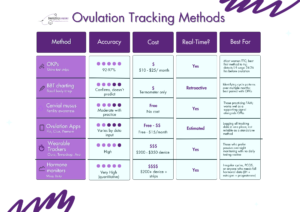
OPKs are urine-based tests that detect the LH surge. They’re affordable, widely available, and impressively accurate when used correctly. A recent study from Brigham and Women’s Hospital found that five popular at-home OPKs all had accuracy rates between roughly 92 and 97 percent, regardless of price. So you don’t need to splurge on the fanciest brand.
Start testing a few days before you expect ovulation, based on your cycle length, and test daily until you get a positive. A positive result means ovulation is likely within the next 24 to 36 hours, so that day and the following day are prime time for intercourse.
A note on timing anxiety — Pinpointing ovulation is useful, but precision isn’t everything. Healthy sperm can survive in quality cervical mucus for 48 to 72 hours — meaning sperm introduced before ovulation may still be available when the egg arrives. The egg itself remains viable for up to 24 hours after release. In practice, this means your effective conception window is wider than a single day. Track your cycle, aim for the fertile window, and try not to stress the exact hour.
BBT charting involves taking your temperature with a sensitive thermometer the moment you wake up each morning, before getting out of bed or even speaking. Over time, you’ll see a clear pattern: lower temperatures during the follicular phase, then a sustained rise after ovulation.
BBT is most useful for confirming that you ovulated and for spotting cycle patterns over several months. As a research review on ovulation detection methods points out, BBT isn’t the best tool for predicting ovulation in real time. But for understanding your cycle over the long haul, it’s valuable.
This method involves checking your cervical mucus daily and tracking how it changes. When mucus turns clear, stretchy, and egg-white-like, ovulation is close. It’s free, it’s based on what’s actually happening in your body, and many women find it surprisingly accurate once they get the hang of it. The downside: there’s a learning curve, and certain things (medications, infections, lubricants) can throw off your readings.
Apps like Flo, Clue, Premom, and Natural Cycles let you log period dates, symptoms, BBT readings, OPK results, and cervical mucus observations all in one place. The best ones use your data over time to predict your fertile window rather than just spitting out a generic 28-day estimate.
Apps work best as a centralized log for the data you’re already collecting through other methods, not as a standalone tool. If you only enter your period dates and let the algorithm guess the rest, you’re getting a calendar-based estimate, which is the least reliable approach.
Devices like Oura, Tempdrop, and Ava measure metrics like skin temperature, heart rate variability, and respiratory rate continuously throughout the night. They can detect subtle physiological shifts around ovulation that you might miss with a manual BBT thermometer. They’re pricier than basic methods but appeal to people who don’t want to remember to test or chart manually.
The newest category includes devices like Mira and Inito, which quantitatively measure hormone levels (LH, estrogen, sometimes progesterone) from urine samples. Unlike traditional OPKs that give a simple positive or negative, these provide actual hormone values, giving you a clearer picture of your cycle. They’re especially helpful for women whose cycles don’t fit neatly into typical patterns.
If your cycles vary wildly month to month, calendar-based methods and standard OPKs can be genuinely frustrating. 14% to 25% of women have irregular menstrual cycles, which can make it harder to know when to even start testing. For women with irregular cycles, continuous tracking methods tend to work better than point-in-time tests. That might mean a wearable that monitors you nightly, a quantitative hormone monitor that tracks the full hormonal arc rather than just the LH surge, or daily OPK testing throughout a wider window of your cycle. Combining methods (an app plus an OPK plus cervical mucus checks, for instance) is even more important when your cycles are unpredictable.
Tracking is incredibly useful, but it has its limits. There are a few signs that suggest it’s worth getting a more thorough evaluation rather than continuing to troubleshoot on your own:
A fertility specialist can run bloodwork to evaluate your hormone levels, use ultrasound to actually visualize what’s happening in your ovaries, and identify issues that no app or test strip will catch. If you’re not sure what that process looks like, here’s what to expect during your first visit. If you’ve been doing the work and aren’t getting answers, schedule a consultation with our team in Chattanooga or Knoxville.